
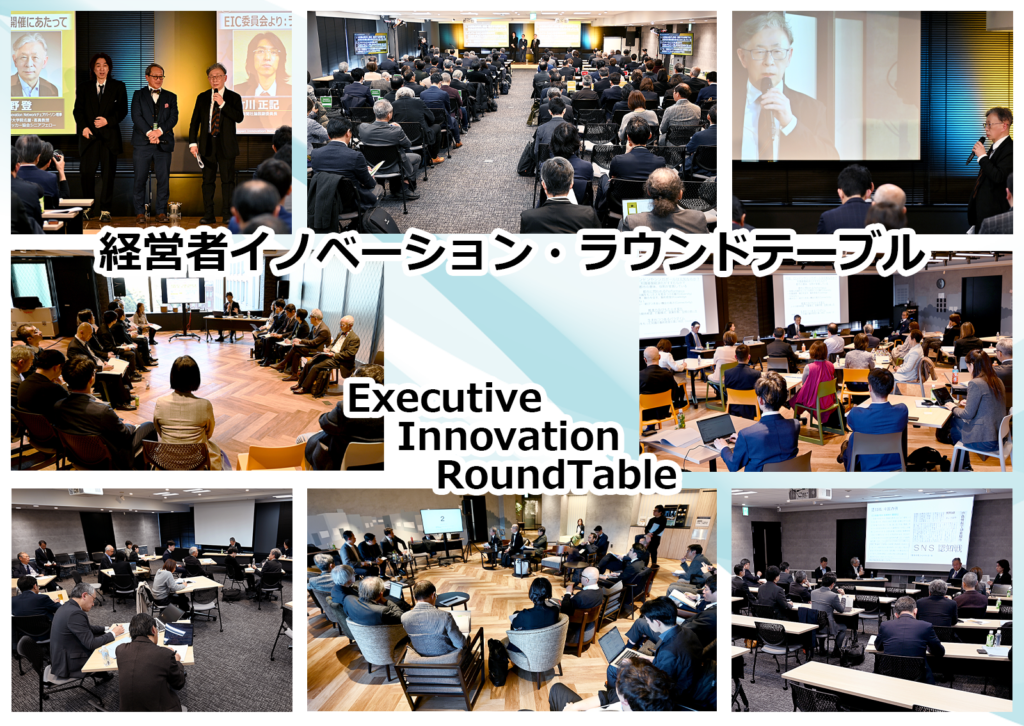
The Executive Innovation RoundTable (EIRT) is a forum for cross-sectoral and practical dialogue among diverse participants from industry, government, academic institutions, and civil society (industry, government, academia, and government), with the core theme of creating innovation in Japan’s society and economy. The purpose of the EIRT is to share fundamental cross-sectoral issues, form a common understanding, and make effective recommendations that will have a broad impact on society. In Japan, there has not been a sufficient forum for industry, government, academia, and the public to gather together for explicit and continuous dialogue. This structural issue has divided sectors and limited the ability of society as a whole to create innovation. The EIRT aims to provide an important foundation for solving this issue and activating the innovation ecosystem of Japanese society as a whole.
Roundtable Statement on Executive Innovation (2025)
This Executive Innovation Roundtable (RT) is a place for practical leaders to envision the next era and generation of society and industry that “has never existed before” beyond the barriers of industry, government, academia and the public.
We will make recommendations on the outcomes of this event and link them to specific activities such as the Innovation Management Award (SIMA). We hope that this will be an opportunity to form an ecosystem for the future.
The purpose of the dialogue is not to discuss individual measures or solutions, but to discuss and share the direction of major changes in Japan as well as the will and vision of the leader.
And it is the first step in a leadership package for change that will serve as its foundation, as well as charting a path to thematic round tables.

Round table 1 (Kanda Myojin Conference): A place for essential dialogue and communication
- Roundtable 1 (Kanda Myojin Conference) was held on August 4, 2025, mainly by corporate members of the Executive Innovation Committee (EIC). The most distinctive feature of this conference is that it is different from conventional conferences. Instead of lectures and panel discussions by a limited number of presenters, all participants at the table participate in discussions on an equal footing, exchange opinions from various perspectives, and form consensus and recommendations. This “all-participant” dialogue format enables problem analysis from multiple perspectives and the creation of creative solutions.
- Round table 1 will use the Chatham House Rule, a code of conduct for meeting participants derived from the Royal Institute of International Affairs in the United Kingdom that allows participants to freely use information received at a meeting, but does not permit them to reveal the identity or affiliation of the speaker. This code allows participants to freely express their opinions without being restricted by organizational positions or interests, and encourages more substantive and creative discussions.
- As a way of conducting the meeting, we will first ask a few participants to raise a brief issue that will serve as a kick-off, and then we will hold a plenary discussion with the support of a facilitator. In order to get the most out of the meeting in a limited amount of time, we will conduct strict timekeeping by having a moderator and a facilitator. We will ask all participants to make their statements concise and to the point. This will effectively consolidate diverse points of view and realize fruitful discussions.
Round table 2 (Future Innovation Round Table): Theme-specific practical open events
- Based on the in-depth discussions and consensus building in Round table 1, Round table 2 (Future Innovation Round Table) will be held on February 3, 2026. This will be an invitation-only event that will invite a wide range of participants. The event will focus on specific industry sectors and policy issues, and will be practice-oriented. In this event, based on the common understanding and awareness of issues formed in Round table 1, more specific solutions and action plans will be formulated, and demonstration projects will be planned.
- By inviting a wide range of participants interested in specific themes and bringing together diverse perspectives and expertise from industry, government, academia, and the general public, we will bridge theory and practice to create effective innovation. This approach will enable us to produce results that will lead to real social change, not just discussions.
| As a new phase of globalization is taking shape, business and society are facing an urgent need to innovate. Rising geopolitical tensions and the increasing use of geo-economic instruments highlight a more politicized climate for business. Meanwhile, society faces the challenges and opportunities of demographic change, climate change, and the energy transition. A whole-of-society approach is called for. It is based on collaboration and shared purpose. I wish you every success as this round table moves forward in the search for solutions. Andrew Staples |
Structure of the Executive Innovation Roundtable
- The purpose of the round-table discussions is not to have a limited number of lectures by speakers or panels, but to have all participants at the table discuss, exchange opinions, form a consensus and make recommendations.
- We would appreciate your frank opinions in accordance with the Chatham House Rules (*).
- Start by asking a few people to say a few words at the kick-off, with the Facilitator’s support to facilitate the discussion
- Please keep your remarks brief and short, as we would like to ask for your cooperation in strict timekeeping by the moderators and facilitators as a way of operating the round table.にお願いいたします。
(※)Chatham House Rule Principles
- Emphasis on Equality
- Emphasis on Diversity
- Emphasis on constructive dialogue
- Emphasis on Mutual Respect
- Consensus Formation and Emphasis
■【OFFICIAL】Announcement of the Release of the Official Report for the “2nd Executive Innovation Roundtable 2025”
https://transformjapan.org/eirt/official_rt1_20250804/