
【REPORT】IM Lab Open Days 2025
2026/06/10
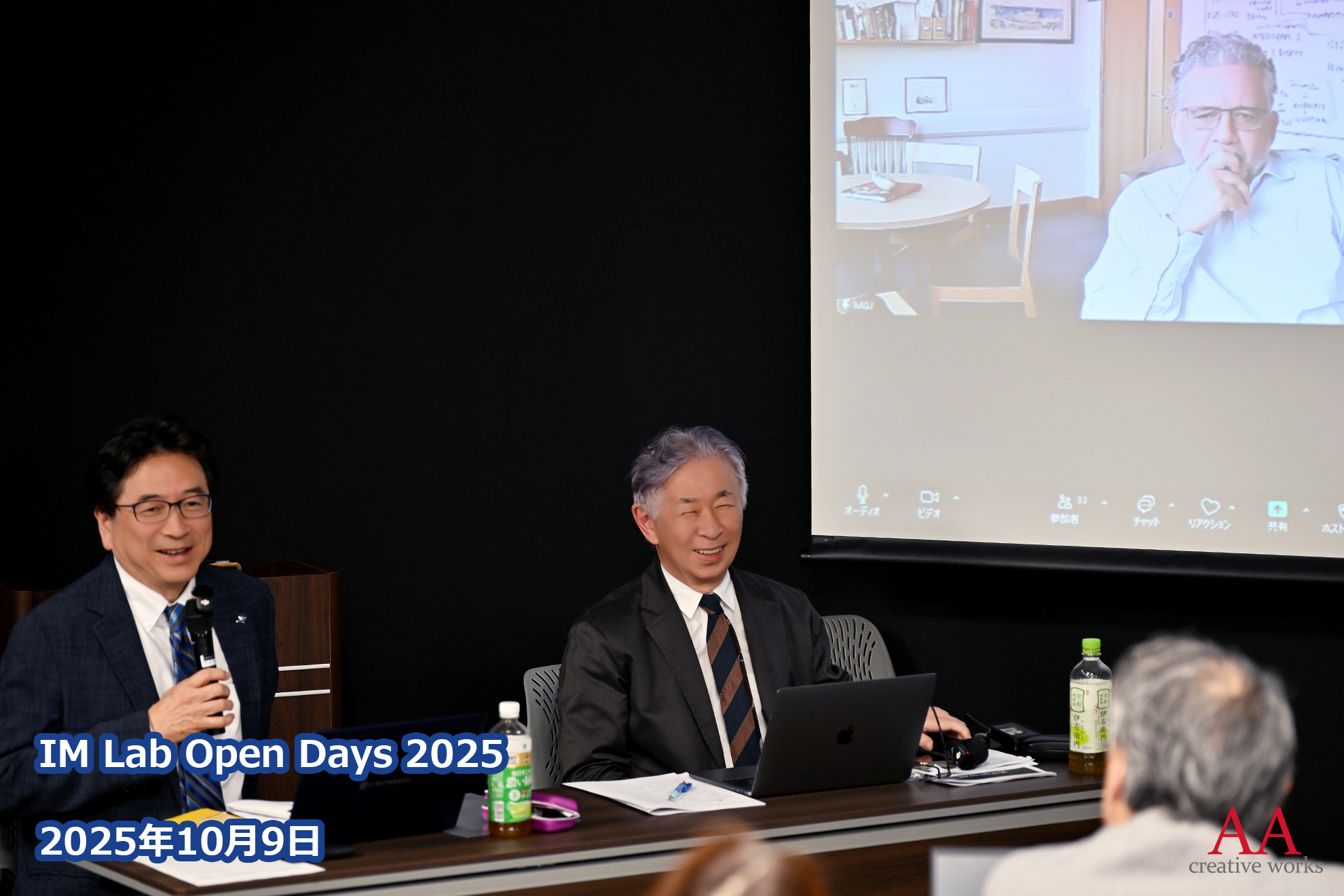
“Following the” “Executive Innovation Roundtable” “held by the Executive Innovation Committee (hereinafter referred to as” “EIC” “) on August 4, 2025,” “IM Lab” “, which supports the construction of an innovation ecosystem through industry-academia collaboration, was launched. In response,” “IM Lab Open Days 2025” “was held on October 9, 2025, sponsored by the Japan Innovation Network (hereinafter referred to as” “JIN” “). We will report on the event and show a digest video. Please watch the digest video by playing the YouTube video in the blue frame below.”
EIC YouTube Channel
IM Lab Open Days 2025(Digest video)
No future for companies without ecosystem strategies
At JIN’s IM Lab Open Days 2025 on October 9, 2025, Professor Michael Jacobides, a world-renowned authority at London Business School, delivered the message that the source of competitive advantage is no longer in individual companies’ value chains. This message resonated deeply with Japanese managers. In an age when ecosystems are competing for hegemony, are Japanese companies “orchestrators” or “partners?” A redefinition of survival strategy is just beginning.
Why Ecosystem Strategy Now?
At the beginning of the event, Mr. Noboru Konno, Chairman of JIN, and Mr. Yoichi Oshima, Professor of Tokyo University of Science and Technology, took the stage to explain the purpose of the activities of IM Lab (Innovation Management Lab). Mr. Noboru Konno raised a problem, saying, “There is no longer a limit to the value chain of a single company. It is essential to build an ecosystem that transcends industry and regional boundaries.” Mr. Yoichi Oshima talked about the methodology and design principles for building an ecosystem and the importance of a new type of human resource called an “ecosystem builder,” and emphasized that IM Lab is a base for intellectual exploration.。
The Decline of the Swiss Watch Industry: A Strategic Failure
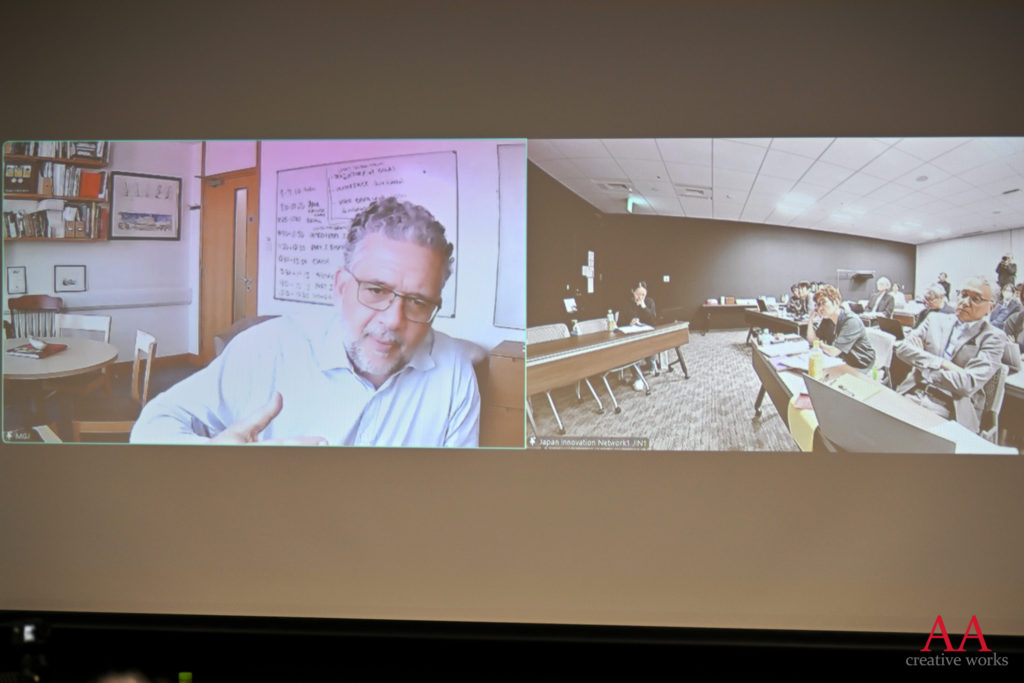
In a special lecture delivered online between London and Tokyo, Professor Michael Jacobides opened with a historical example of the Swiss watch industry’s failure to catch the digital wave. He argues that the Swiss watch industry’s failure to catch the digital wave was not simply a failure to innovate. It was an unmistakable strategic mistake that resulted from “overconfidence in one’s own strengths and a failure to see the changing external environment and the resulting ecosystem realignment.”
Professor Michael Jacobides defines modern business as an “era of ecosystem competition.” Companies can strategically position themselves in only three ways: as “orchestrators,” in command of entire ecosystems; as “partners,” in charge of core functions; and as “complementators,” to be complemented by products and services.
Professor Michael Jacobides emphasizes a very practical point of view: “Not everyone needs to be an orchestrator.” Citing the failures of even giants like General Electric and Microsoft, he says, “It’s critical that you deeply understand your value proposition and identify where your strengths lie.” With generative AI disrupting sector boundaries and physical and digital converging, the ability to continue to redefine your business model can mean the difference between life and death.
At the end of his talk, Professor Michael Jacobides posed simple but essential questions: “What is your ecosystem strategy?” and “What role should I play in maximizing my company’s value?”
Japan’s Issues Highlighted: Insensitivity to Change and Absence of Enablers
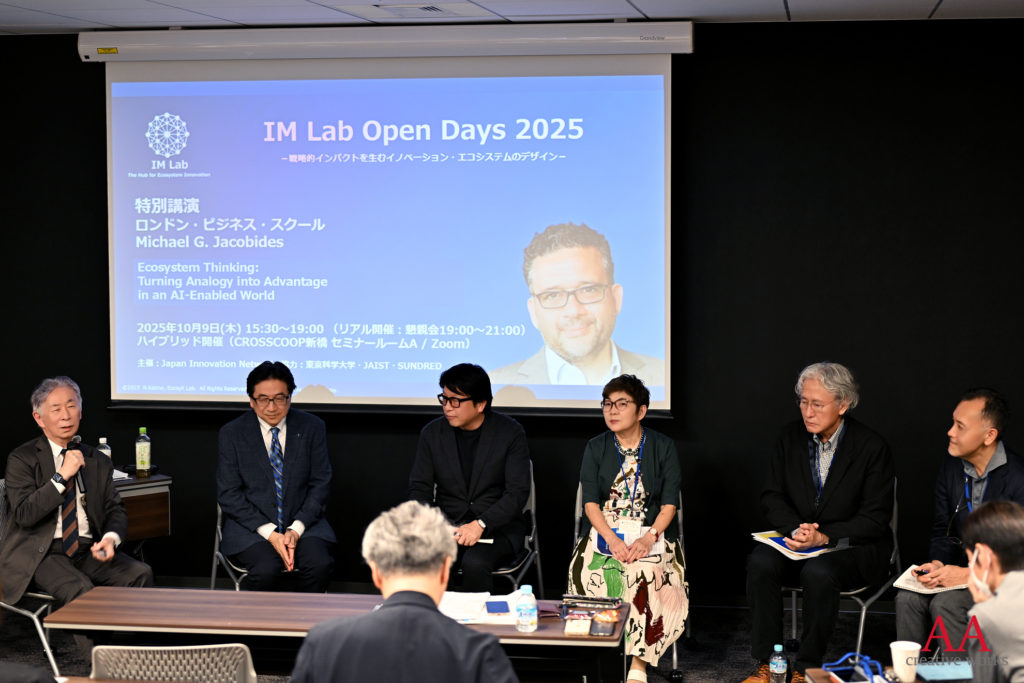
In response to the question raised by Professor Michael Jacobides, the current Japanese situation was broached in a panel discussion. In addition to Mr. Noboru Konno and Mr. Yoichi Oshima from “Team IM Lab,” which plays a central role in IM Lab, and Mr. Masanobu Todome, President of SUNDRED, Inc., there were a total of six “IM Lab members”: Mr. Sumie Morita, Professor of Akita Prefectural University, Mr. Hajime Imamura, Professor Emeritus of Toyo University and Representative Director of CREAPS-DESIGN, and Mr. Masaru Sato, J-FEEL Consultant, Inc.
“While the word’ ecosystem’ is in vogue, many Japanese companies are just’ similar’ and have not been able to work together,” said Masanobu Todome, who started the idea. Noboru Konno also warned about the insensitivity to changes, saying, “Overseas, it is natural to catch changes in the business environment in real time and revise strategies. However, Japanese managers only see the world in their own company’s time frame.”
Why can’t Japan change? Oshima Yoichi, citing the daily conversation “May I have your cup?” as an example, analyzed the cultural background, saying, “Japanese society has a strong tendency to think that maintaining the status quo is better than change.” He suggested that this “culture that is afraid of change” may be blocking new challenges.
In addition, there were questions from the audience about structural problems. There was a lack of literacy in the human resources called “enablers” in universities and intermediate support organizations that support start-ups. “Even if there are motivated entrepreneurs and researchers, there is no system or human resources developed to support and scale them.” There was a current situation that could be said to be a waste of a treasure.
Is conceptual power at the national level necessary? Challenges from the “seedbed” of the ecosystem
It’s not just pessimism. Hajime Imamura touched on the importance of exchanges between different fields at academic conferences in Europe and proposed the cultivation of a culture of open dialogue, saying, “A place to exchange knowledge is a source of new ideas.”文化の醸成を提案。
In the end, the discussion developed into the big question of whether Japan needed the conceptual power of the national level in order to build an ecosystem. There was no clear answer as to whether it should be a top-down or bottom-up approach. However, they agreed on the need for industry, government, and academia to cooperate and play their respective roles.
“The IM Lab itself is the nursery of the ecosystem,” Noboru Konno concluded. Companies without ecosystem strategies have no future. Can Japanese leaders position themselves and design the future in the face of this cold reality? The challenge has only just begun.




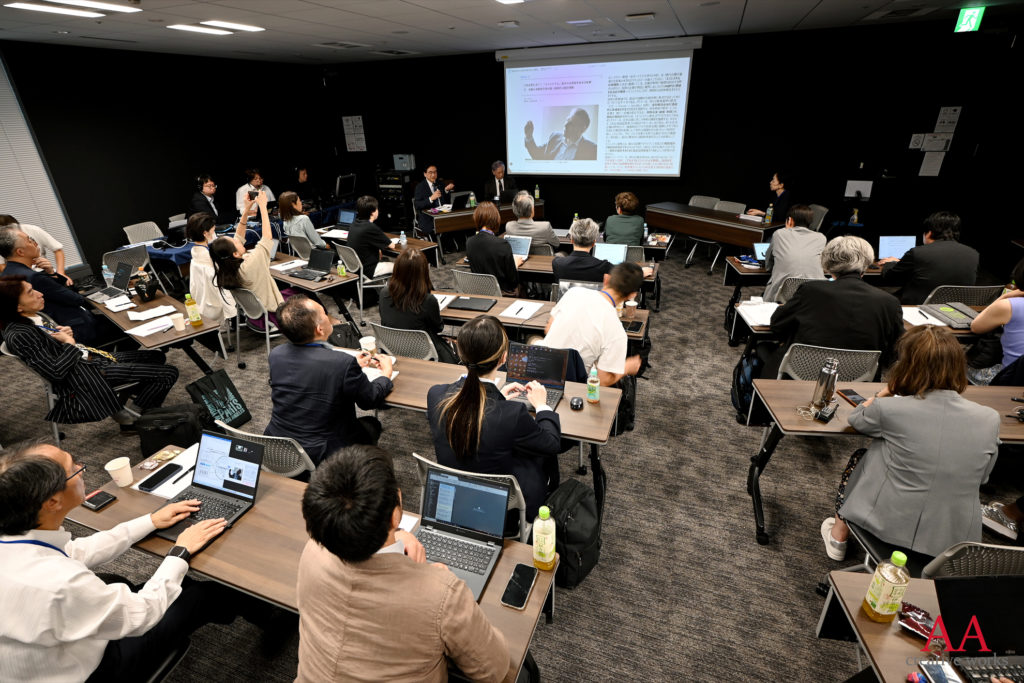
IM Lab Open Days 2025
Event Name: IM Lab Open Days 2025
Date and Time: Thursday, October 9, 2025, 3:30 PM – 7:00 PM
Location: 3rd Floor, Urban Net Uchisaiwaicho Building, 1-1-13 Shimbashi, Minato-ku, Tokyo
CROSSCOOP Seminar Room A
Organized by: Japan Innovation Network (JIN)
Agenda:
3:30–4:00 p.m. Opening Session
4:15 PM – 6:00 PM Special Lecture by Professor Michael Jacobides of London Business School: “Ecosystem Strategy as Competitive Advantage”
6:00 PM – 7:00 PM Panel Discussion on Ecosystem Strategy by Team IM Lab (Oshima, Tome, Konno)
7:00 PM – 9:00 PM Networking Reception
◆関連記事
・【REPORT】IM Lab Open Day #2 2025
https://transformjapan.org/perspectives/20260123/
・【REPORT】Noboru Konno at the European Drucker Association Senior Fellow Award Ceremony
https://transformjapan.org/perspectives/20250701/
・【REPORT】First SIMA (Good Innovation Award) award ceremony
https://transformjapan.org/sima/report_sm1_20260203/