
[REPORT] The 1st SIMA “Good Innovation Award” Ceremony
2026/05/14
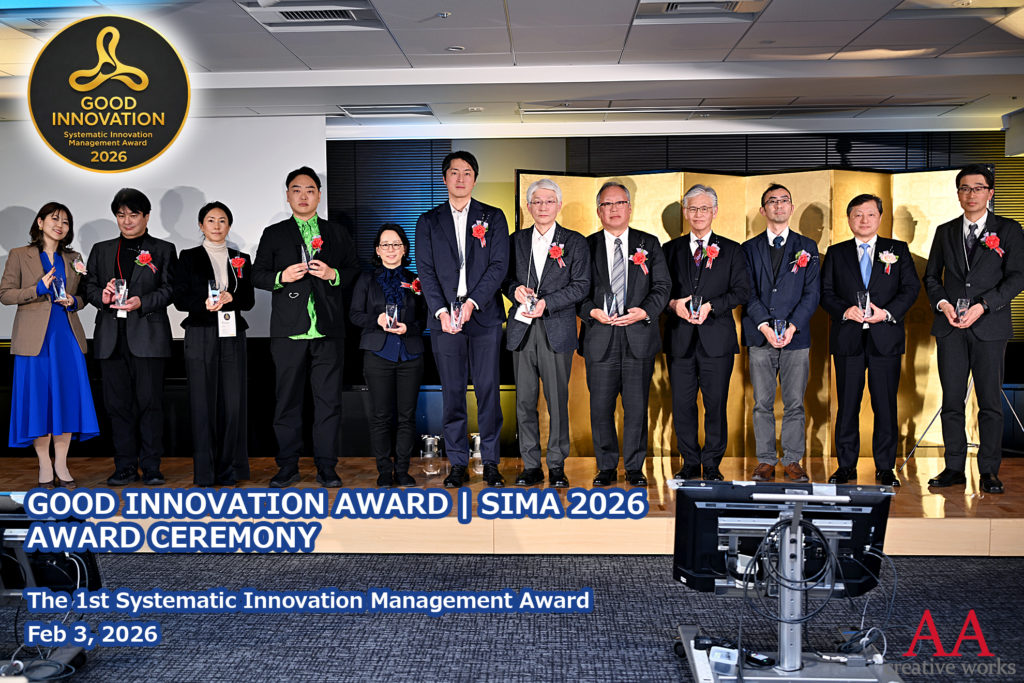
On February 3, 2026, the Executive Innovation Committee (hereinafter referred to as EIC) hosted the inaugural presentation ceremony for the “Systematic Innovation Management Award” (hereinafter referred to as SIMA) during the Executive Innovation Roundtable 2, titled “Future Innovation Roundtable.”
This report and the accompanying video footage offer a comprehensive overview of the proceedings. We invite you to view the event by playing the YouTube video embedded in the blue frame below.
EIC YouTube Channel
The 1st SIMA “Good Innovation Award” Ceremony
[Japanese Language Only]
The 1st SIMA “Good Innovation Award” Ceremony: Merging Intellectual Discipline with Creative Power
Japan’s “Lost Thirty Years” were not a result of a deficit in technical prowess. Rather, the root cause lay in the absence of a “Management System” capable of institutionally reproducing and scaling innovation. Just as “Quality Control” (QC)—once the hallmark of Japanese excellence—elevated manufacturing discipline to a global standard, we are now witnessing a fundamental paradigm shift: the management of innovation itself as a structured system.
Based on the “Systematic Innovation Management” framework advocated by the EIC, this award evaluates innovation management through a multifaceted lens—including social contribution, organizational creativity, and the sustainability of value-creating systems. This distinction sets SIMA apart from traditional accolades that merely celebrate “superior products or services.” At its core, the award interrogates an organization’s “Capability” to generate value consistently and sustainably.
IMS: The “Kata” of Innovation Management
At the opening of the ceremony, Noboru Konno, Chairperson of JIN, delivered a candid assessment of the current state of Japanese business, noting that many new ventures remain trapped in a “three-in-a-thousand” gamble, relying more on luck than logic. An Innovation Management System (IMS) moves beyond a reliance on individual passion or serendipity; it defines the entire process—from ideation and concept validation to commercialization and scaling—as an organizational “routine.” The thirteen award-winning organizations have successfully embodied this “system,” strategically taming an uncertain future through logical discipline.
The following sections introduce the transformative challenges undertaken by each of these pioneers.
Nominated Organizations (23 Total)
Listed in alphabetical order
・AGC Inc.
(Formerly Asahi Glass Co., Ltd.)
・AGRIST Inc.
・Akiya Katsuyo Co., Ltd.
・Center for Supercentenarian Medical Research, Keio University School of Medicine
・Consumers Co-operative Sapporo (Co-op Sapporo)
・Daikin Industries, Ltd.
・FonesLife Corporation
・Ishizaka Sangyo Co., Ltd.
・Kansai Resource Recycling Network Co., Ltd.
・Maebashi Design Commission (MDC)
・Mitsui Fudosan Co., Ltd.
・Motherhouse Co., Ltd.
・M-Square Lab Inc. (Vegibus)
・NanoTerasu (Photon Science Innovation Center: PhoSIC)
・Nikken Sekkei Ltd (PYNT)
・Nippon Telegraph and Telephone West Corporation (NTT WEST)
・SIGMA Corporation (Headquarters: Hiroshima)
・SOMAY-Q Technology Corporation
・Sony Computer Science Laboratories, Inc.
・Space Service Innovation Lab (SSIL) Association
・Synspective Inc.
・Three-Institution Collaboration of Kitakyushu (Kitakyushu Science and Research Park)
・Wood Plastic Technology Co., Ltd.
Good Innovation Grand Prix (5 Organizations)
Listed in alphabetical order
・Consumers Co-operative Sapporo (Co-op Sapporo)
・Daikin Industries, Ltd.
・M-Square Lab Inc. (Vegibus)
・NanoTerasu and Regional Partners
・Synspective Inc.
Creation Award for Good Innovation (3 Organizations)
Listed in alphabetical order
・Mitsui Fudosan Co., Ltd.
・Nikken Sekkei PYNT
・Wood Plastic Technology Co., Ltd.
Systematic Award for Good Innovation (5 Organizations)
Listed in alphabetical order
・AGC Inc.
・AGRIST Inc.
・FonesLife Corporation
・Ishizaka Sangyo Co., Ltd.
・SIGMA Corporation (Hiroshima)


Exemplary Pioneers: The Good Innovation Grand Prix
(5 Organizations / Listed in alphabetical order)
The Grand Prix was awarded to truly exemplary enterprises that demonstrate excellence in both systematic mechanisms and creativity, spearheading the advancement of innovation management in Japan.
•Consumers Co-operative Sapporo (Co-op Sapporo)
Rewriting the Corporate OS: The Convergence of DX and Innovation in a Large-Scale Organization


It is exceedingly rare for an organization of this scale—commanding a membership base of over one million—to achieve such a dramatic and fundamental metamorphosis. They have successfully implemented digital technology not as a mere tool, but as a core mechanism to revitalize the very fabric of their organizational culture. Their “democratic innovation system,” which identifies latent needs through active member dialogue and translates them into rapid real-world application, serves as a definitive prescription for the survival of legacy organizations in an era of disruption.
Consumer Co-operative Co-op Sapporo [Press Releases and Related Media Regarding the SIMA Award]
https://www.sapporo.coop/information/press/5336.html
Strategic Synergy: Corporate Venturing Fueled by Executive Vision and Operational Discipline


The global leader in air conditioning solutions has demonstrated exemplary discipline in architecting its Corporate Venturing Innovation (CVI) framework, designed to seamlessly integrate external expertise into the organization. Backed by an unwavering commitment from top management, the company has institutionalized a “two-tier” governance model. This structure ensures that collaborations with startups and internal ventures are strategically nurtured and insulated from being stifled by the conventional logic of legacy business units. Their approach serves as a definitive embodiment of the “strategic discipline” required for Japanese manufacturers to regain their global preeminence.
Bridging Logistics Gaps: The Definitive Model of a Collaborative Ecosystem
-01-1024x683.jpg)
-02-1024x683.jpg)
-03-1024x683.jpg)
The shared agricultural logistics network “Vegibus” is far more than a mere transportation platform; it represents a paradigmatic case of regional economic redesign. By unifying a diverse spectrum of actors—from producers and consumers to incumbent logistics providers—under a singular, shared purpose, it has effectively reshaped the local economic landscape. Its true brilliance lies in the systematization of social problem-solving as a primary engine for business growth, utilizing a structured framework to harmonize conflicting stakeholder interests. Vegibus stands as a definitive proof that innovations born in rural regions can transcend local boundaries to become global benchmarks.
M-Square Lab Inc. (Vegibus) [Press Releases and Related Media Regarding the SIMA Award]
https://www.facebook.com/M2labo/posts/pfbid02sgT3DeWLQ1yeNwapVMHw5wHoveSTzLvjBtDYZoiSUvjmr5kpiv4PoPDMs8usGJGPl
•NanoTerasu and Regional Partners
Accelerating Social Implementation: A Grand-Scale Public-Private Co-creation Platform for Science and Technology


NanoTerasu, the colossal “nanoscale microscope” recently inaugurated in Sendai, Tohoku. The facility’s selection for the Grand Prix is a testament not only to its formidable technological capabilities but, more crucially, to its innovative operational framework. By mobilizing a “coalition of the willing”—comprising national and regional governments as well as private-sector enterprises—it has established the “Regional Partner System.” This groundbreaking ecosystem directly translates cutting-edge science into industrial competitive advantage. As a management system that seamlessly bridges the gap between scientific research and commercial application, NanoTerasu possesses the potential to catalyze a paradigm shift in Japan’s national R&D strategy.
NanoTerasu and Regional Partners [Press Releases and Related Media Regarding the SIMA Award]
https://www.phosic.or.jp/news/2025/award_sima.html
The Convergence of Satellite Data and Agile Decision-Making


Specializing in the development and operation of small SAR (Synthetic Aperture Radar) satellites, the firm has achieved a rare integration of inherent startup agility with a robust management system that meets the rigors of international standards. In the space sector—an industry characterized by high uncertainty—the company was highly commended for its organizational mechanisms that execute evidence-based learning cycles with precision. Their Innovation Management System (hereinafter referred to as IMS) is poised to become the essential infrastructure for Japanese startups to achieve sustainable success on the global stage.
Architects of New Frontiers: Creation Award for Good Innovation
(3 Organizations / Listed in alphabetical order)
The Creation Award was bestowed upon enterprises that, in addition to adopting a systematic perspective, are actively fostering the emergence of new industries and transformative social ecosystems.
Transforming Urban Development into a Strategic Platform for Continuous Innovation


As Japan’s premier real estate developer, the firm has fundamentally reimagined the urban landscape, viewing cities not merely as an agglomeration of physical structures, but as dynamic “innovation ecosystems.” Through its landmark initiatives in districts such as Nihonbashi and Kashiwa-no-ha, the company has established a sophisticated framework where industry, academia, government, and local residents collaborate as a unified force to tackle complex societal challenges. By embedding IMS into the very fabric of urban management to drive sustainable value appreciation, the sheer magnitude and ambition of its vision remain unparalleled in the industry.
Architecting Platforms as Dynamic Hubs for Co-creation


Transcending the traditional boundaries of architectural design, Nikken Sekkei established “PYNT” as a strategic nexus for innovation. Far from being a mere co-working space, PYNT serves as a dedicated field for the practical application of IMS, where diverse professionals with disparate expertise converge to iteratively validate new hypotheses. The firm received high acclaim for its successful paradigm shift—transitioning the core of its value proposition from the “hardware” of architectural structures to the “software” of the innovation processes themselves.
•Wood Plastic Technology Co., Ltd.
Systemic Frameworks for the Social Implementation of New Materials to Realize a Circular Economy


Far more than a conventional material supplier, the firm develops biomass-based plastic substitutes derived from underutilized timber. Through its Innovation Management System (IMS), the company has architected the very “circular framework” necessary for its materials to be distributed and continuously recycled within society. By achieving a sophisticated synthesis of environmental conservation and economic viability, their management model serves as a quintessential prototype for a truly sustainable industrial architecture.
Wood Plastic Technology Co., Ltd. [Press Releases and Related Media Regarding the SIMA Award]
https://wpt.co.jp/news/index.html#news_20260205
Mastering Strategic Frameworks: Systematic Award for Good Innovation
(5 Organizations / Listed in alphabetical order)
The Systematic Award was conferred upon organizations that have robustly architected the internal and external processes essential for driving and sustaining innovation.
Systematizing Ambidextrous Management: Integration from Strategy to the Organizational Frontlines


Transitioning from “AGC the Glassmaker” to a comprehensive platform for advanced materials, the firm’s metamorphosis has been underpinned by the implementation of a sophisticated IMS. This system simultaneously manages the “exploitation” of core businesses and the “exploration” of new frontiers—a hallmark of ambidextrous management. Central to this success is the rigorous execution of stage-gate processes that seamlessly bridge top-down strategic directives with bottom-up ideation. In a massive, capital-intensive industry, AGC provides a definitive answer to the fundamental question of how to institutionalize flexible innovation at scale.
AGC Inc. [Press Releases and Related Media Regarding the SIMA Award]
https://www.agc.com/news/detail/1210658_2148.html
Ultra-Rapid Iteration Systems: The Frontier of Agricultural Robotics Development


Aspiring to the global stage from its roots in Shintomi, Miyazaki, the firm has architected an “accelerated learning system” that integrates real-time feedback from the agricultural frontlines into its development cycle. Their IMS is defined by a rigorous discipline of “failing fast and improving faster,” prioritizing rapid iteration over mere technological precision. The company offers a compelling answer to how a rural startup can forge world-class technology.
AGRIST Inc. [Press Releases and Related Media Regarding the SIMA Award]
https://www.agrinews.co.jp/news/prtimes/366414
https://news.nicovideo.jp/watch/nw19008091
https://www.jacom.or.jp/shizai/news/2026/03/260313-88062.php
Orchestrating Healthcare Ecosystems: Predicting the Future through Blood Data Insights


By synergizing the NEC Group’s technological prowess with global expertise, the company has successfully systematized a business model centered on pre-symptomatic and preventive healthcare. Moving beyond the mere provision of diagnostic services, it has meticulously designed a data-driven ecosystem that interconnects insurance providers, medical institutions, and individual users, leveraging IMS methodologies. In the high-uncertainty domain of healthcare, the company was highly commended for its institutionalized process of cultivating trust and generating sustainable value.
FonesLife Corporation [Press Releases and Related Media Regarding the SIMA Award]
https://foneslife.com/news/20260209-1/
https://x.com/FonesLife/status/2021071630106071348
A Sophisticated Management System Transforming Industrial Waste Disposal into a Resource Recovery Business


Defying conventional industry norms, the firm has transformed an industrial waste processing facility into a site for “Satoyama restoration,” evolving into a visionary “infrastructure company of the future” that draws visitors from across the globe. Behind this metamorphosis lies a meticulously crafted management system that seamlessly integrates environmental education, ISO standards, and a fundamental reform of employee consciousness. By successfully institutionalizing these values into its core organizational routines, the company has established itself as a definitive benchmark for all industrial sectors.
Ishizaka Sangyo Co., Ltd. [Press Releases and Related Media Regarding the SIMA Award]
https://ishizaka-group.co.jp/news/20260213/
https://www.facebook.com/share/p/1LVbyNCkwB/?mibextid=wwXIfr
•SIGMA Corporation (Hiroshima)
The Golden Ratio of Systematic Infrastructure and Human Talent: A Data-Driven Environmental Management System

Moving beyond a reliance on individual brilliance, the firm has established a reproducible infrastructure for innovation anchored in its unique organizational philosophy. By institutionalizing an improvement cycle that integrates equipment operational data with electricity usage analysis, the company delivered formidable results between 2021 and 2024, including a reduction in CO2 emissions of approximately 300 tons and a 16% enhancement in energy efficiency per production unit. Their systematic management—defined by a dual-track development model combining in-house expertise with open innovation, alongside a long-term talent cultivation strategy centered on comprehensive learning support—earned high praise for its operational excellence and scalability.
SIGMA Corporation (Hiroshima) [Press Releases and Related Media Regarding the SIMA Award]
https://sigma-k.co.jp/news/fqLFLJ-V
Conclusion: Systems as the Catalyst for Japan’s Resurgence
To summarize the inaugural SIMA ceremony is to witness a “Redefinition of Discipline” within Japanese industry. In decades past, Japanese enterprises achieved global dominance through “Quality Control” (QC) on the factory floor. However, in today’s era of unprecedented uncertainty, the strategic imperative has shifted from the production line to the executive suite: the implementation of Innovation Management Systems (IMS).
A singular, resonant message echoed from the leaders of the 13 award-winning organizations: “The establishment of a common language—a system—has dissolved internal silos and accelerated external co-creation.” This process of “Standardization”—transforming innovation from an extraordinary feat by exceptional individuals into a routine organizational function—is the definitive and most formidable weapon for Japan to regain its global preeminence.
The pioneers honored by SIMA have demonstrated more than mere business success; they have provided the prototype for a new “Industrial OS” designed to win through systematic excellence. As the wave of transformation ignited by this ceremony permeates every corner of Japanese industry, we will, both in name and in fact, witness the definitive conclusion of the “Lost Decades.”


The Inaugural SIMA “Good Innovation Award” Ceremony
Date & Time: Tuesday, February 3, 2026 | 18:00-18:45
Venue: Hibiya Kokusai Building Conference Square
(8F, 2-2-3 Uchisaiwaicho, Chiyoda-ku, Tokyo)
Curated by: Executive Innovation Committee (EIC)
Organized by: Japan Innovation Network (JIN)
Noboru Konno Chairperson, Japan Innovation Network (JIN) Featured Editorials on Note
Announcement of the SIMA Good Innovation Award 2026
https://note.com/ecosyx_lab/n/n0bb24faf5870?app_launch=false
Announcement of the SIMA Good Innovation Award 2026
https://note.com/kousouryokunikki/n/nbdfbcf9d3a5f


•Related Articles [Japanese Language Only]
[REPORT] Executive Innovation Roundtable 2: “Future Innovation Roundtable”
https://transformjapan.org/eirt/report_rt2_20260203/
[REPORT] The 2nd Executive Innovation Roundtable
https://transformjapan.org/eirt/report_rt1_20250804/
[OFFICIAL] Announcement: Publication of the “2nd Executive Innovation Roundtable 2025” Official Report
https://transformjapan.org/eirt/official_rt1_20250804/